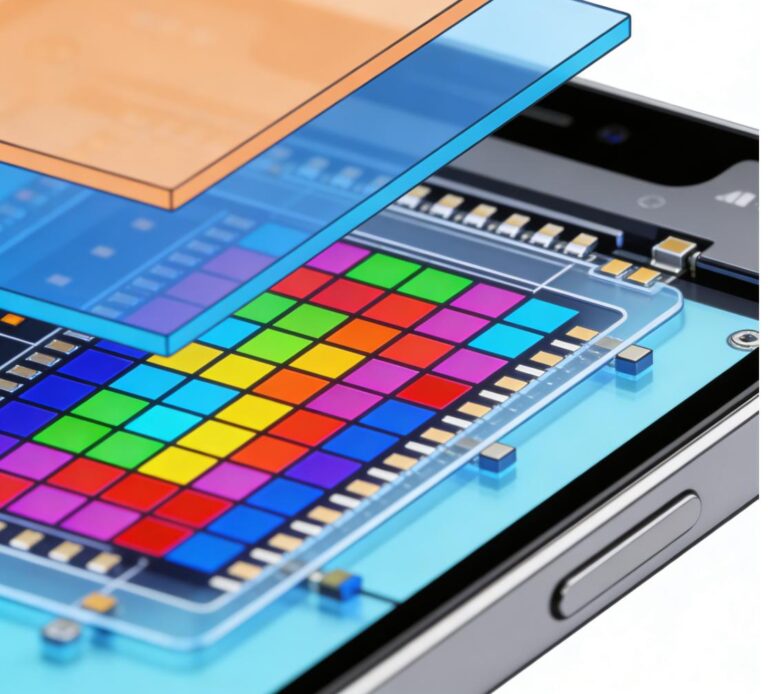


In modern electronic devices, touch technology has become the main interface between users and screens. Among various solutions, on-cell touch screen technology stands out for its balance between cost, performance, and design flexibility. It has been widely adopted in smartphones, tablets, automotive displays, and industrial equipment. But what exactly is an on-cell touch screen, and how does it compare to other technologies?
Understanding On-Cell Touch Screen Technology
1. Basic Structure
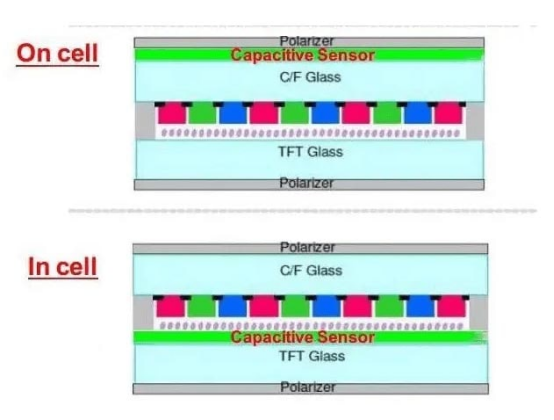
An on-cell touch screen integrates the touch sensor layer directly onto the top layer of the display’s glass substrate. In other words, the touch electrodes are built into the display panel itself, usually between the color filter glass and the polarizer.
Unlike the in-cell method (where sensors are embedded inside the LCD structure) or add-on touch panels (where sensors are attached as a separate layer), on-cell technology strikes a balance by embedding the sensor on the display surface. This results in a thinner profile while maintaining high yield during manufacturing.
2. Working Principle
The on-cell panel typically uses capacitive sensing, where a grid of transparent electrodes detects touch by measuring small changes in capacitance caused by a finger or stylus. These signals are processed by a touch controller IC, allowing precise detection of touch points even with protective glass of up to 1.1–1.5 mm thickness.

Advantages of On-Cell Touch Screen Technology*
1. Thinner and Lighter Design
By combining the touch and display layers, the total module thickness can be reduced by approximately 0.5–0.8 mm compared with traditional add-on touch modules. This makes on-cell a preferred choice for ultra-slim devices such as smartphones and portable displays.
2. Better Optical Performance
Fewer layers mean less light reflection and better transmittance. In practice, on-cell displays can achieve up to 92% optical transmittance, improving brightness and reducing power consumption. The reduction in air gaps also minimizes internal reflection, enhancing contrast under strong ambient light.

3. Cost Efficiency
Manufacturing cost is about 10–15% lower than in-cell technology because the process is less complex and offers higher yield rates. This cost advantage makes it suitable for mid-range consumer products and industrial devices where cost-performance balance is key.
4. Enhanced Touch Response
On-cell touch screens typically support multi-touch gestures with a response time under 8 milliseconds. This ensures smooth, real-time interaction, particularly important for applications such as automotive control panels or gaming displays.
Comparison: On-Cell vs. In-Cell and Add-On Touch
| Feature | On-Cell | In-Cell | Add-On |
| Structure | Sensor on top of display glass | Sensor integrated within LCD | Separate touch layer |
| Thickness | Medium (≈1.2 mm) | Thinnest (≈1.0 mm) | Thickest (≈1.8 mm) |
| Yield rate | High (85–90%) | Moderate (70–80%) | High (90%+) |
| Optical clarity | Excellent | Excellent | Good |
| Cost | Moderate | High | Low |
| Durability | Good | Medium | High |
From this comparison, we can see that on-cell technology provides a middle ground — thinner and clearer than add-on solutions, but more affordable and easier to mass-produce than in-cell designs.
Applications of On-Cell Touch Screens
1. Consumer Electronics
On-cell touch displays are widely used in smartphones, tablets, and handheld gaming consoles. Brands often choose on-cell for mid-tier models where they can offer a balance of visual performance and cost control.
2. Automotive Displays
In automotive environments, reliability is crucial. On-cell touch panels offer stable performance across a wide temperature range (–30°C to +85°C) and can be paired with anti-glare or anti-reflection coatings. This makes them ideal for car infotainment systems, dashboards, and navigation screens.
3. Industrial and Medical Equipment
Industrial monitors and medical devices benefit from on-cell’s durability and clarity. Since these applications often require glove touch or wet-hand operation, customized on-cell modules can be tuned for high sensitivity through controller firmware.

Conclusion
The on-cell touch screen represents a key milestone in the evolution of display integration. It offers an effective compromise between thinness, cost, and optical quality, making it a dominant choice for mid-to-high-end devices. With advancements in materials and touch controller algorithms, on-cell technology is expected to extend beyond LCDs into next-generation flexible and high-brightness display systems.
At Easy Quick Technology, we provide comprehensive solutions across Add-On, On-Cell, and In-Cell touch technologies, tailored to meet diverse application requirements—from industrial control panels to automotive and consumer displays. Backed by years of manufacturing expertise and advanced optical bonding capabilities, our team ensures every touch display delivers exceptional clarity, responsiveness, and durability.
Ultimately, as users demand faster, thinner, and more reliable interfaces, Easy Quick will continue to innovate and support partners worldwide with professional, customized display solutions that bring technology and interaction closer together.