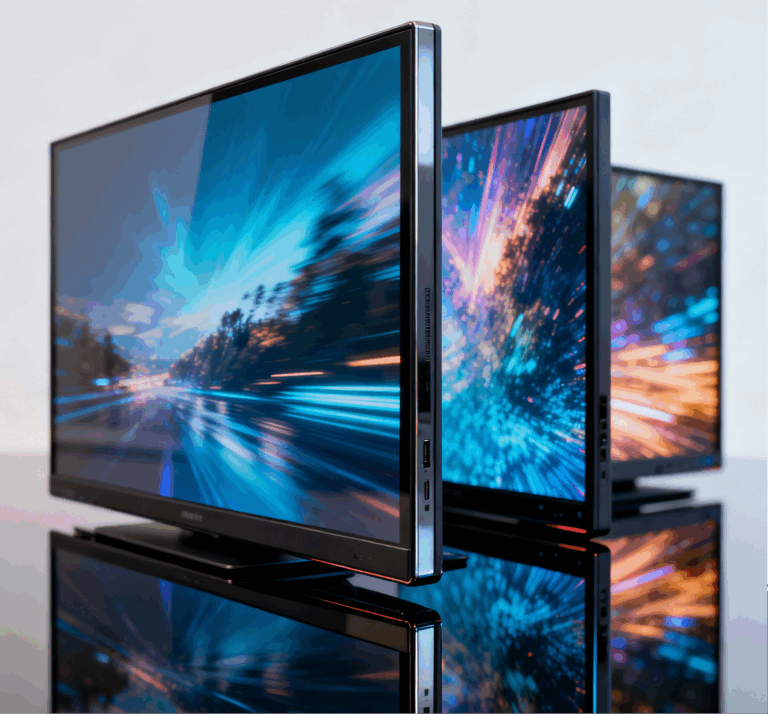


Currently, in electronic devices, the most commonly used display technologies include Liquid Crystal Displays and Liquid Crystal Modules. While the names may sound similar, these two technologies differ greatly in terms of design, functionality, and use. Learning about the difference between LCM vs LCD displays is an important factor in designing electronic devices, choosing components related to display technology, and analyzing the cost of the displays. This is an important factor for engineers, procurement professionals, and business users looking for display solutions.
What Is an LCD Display?

An example of a non-emissive display technology is an LCD, which makes use of the optical properties of a liquid crystal to control light and create images. It is made up of a layer of liquid crystals, polarizers, glass substrates, and a backlight support system, with advances in technology having ensured an affordable cost for its use in making displays in devices.
Key features of LCD:
- Non-self-emissive: An LCD is non-self-emissive because it is unable to produce its own display light. The molecules used in liquid crystals can control the passage of light; however, an outside light source is required in order for images to be produced on the screen. This makes an LCD capable of producing an even level of brightness regardless of screen size and consuming low power.
- Energy-efficient: When discussing energy efficiency, it is obvious that an LCD is much more energy efficient than a CRT and a plasma panel because the transition of a liquid crystal from one condition to another takes very little energy, and an LED-backlit screen is long-lasting and energy efficient.
- Vivid colors: Due to the advancement in the technologies of both IPS and VA, the overall performance of an LCD concerning the angle of view, color accuracy, and luminance has increased dramatically. Although the contrast ratio is lower than in self-emitting displays, an LCD boasts smooth transitions of colors and high-quality graphics, targeting appliances and professional visual solutions.
What Is an LCM Display?

An LCM (Liquid Crystal Module) is a display module built on top of an LCD panel, with additional components such as a driver IC, circuit board, backlight, and structural parts integrated into a single unit. Compared with the basic LCD panel, an LCM is more like a complete display module ready to be installed into devices.
Key features of LCM:
- Higher integration: LCMs integrate the LCD panel, IC drivers, circuit boards on FPC, interfaces for power and signals, BL components, and other mechanical parts. The level of integration makes an LCM reliable and insensitive to EM fields, vibrations, and other environmental factors, which is essential in rugged applications such as industry and the automotive industry.
- Easy to integrate: Because the driver circuitry and interfaces are already built in, users only need to connect via standard display interfaces such as RGB, SPI, LVDS, or MIPI. There is no need to design complex external driving circuits, reducing development time and minimizing risks during display tuning. LCMs greatly accelerate time-to-market, especially for teams without display engineering experience.
- More functional: LCMs support enhanced features such as backlight dimming, integrated touch panels (CTP), varied resolutions, wide-temperature designs, and customization for specific industries. Many LCMs are optimized for medical, industrial, or automotive applications, offering far more flexibility than basic LCD panels.
Key Differences Between LCM vs LCD display
| Feature | LCD Display | LCM Display |
| Integration Level | Only includes the LCD panel | Includes panel, driver IC, backlight, etc. |
| Application | TVs, phones, computers, consumer devices | Embedded and industrial devices |
| Ease of Use | Needs external circuits and drivers | Plug-and-play with integrated drivers |
| Functionality | Basic display | Extra features like dimming, touch, etc. |
| Cost | Lower | Higher, but more integrated |
Which Is Better for Your Project: LCM vs LCD display?
Choose LCD if:
The LCD will be a much more cost-effective choice if the project only requires a very basic display panel, and you can support the design of driver circuitry and external components.
In those cases where your application requires only standard display functionality, such as in a TV, smartphone, or monitor, LCDs will be perfect. Mainly used in consumer and industrial products, they will do just fine in case additional circuitry development is feasible.
An LCD display can offer variations in size and resolution and include choices for backlighting; hence, it’s one of the more versatile budget options for most standard projects.
Choose LCM if:
If you require a higher degree of integration and want to simplify the development process, then an LCM is better. The Liquid Crystal Module includes the display panel, driver IC, backlighting, and connectors already assembled and therefore is much easier to work with.
They are ideal for embedded systems, industrial panels, or displays for the automotive industry, where reliability and fast integration are paramount. They also offer advanced functionality such as touchscreen integration and dimmable backlight, and are thus ideal for more specialized applications.
Conclusion
LCM and LCD represent two different levels of display technology. In the comparison of LCM vs LCD display, LCDs function as cost-effective, foundational display components, making them popular across consumer and industrial devices. LCMs, meanwhile, offer enhanced reliability, added features, and simplified system integration—making them ideal for professional and embedded applications.
If you are looking for high-quality and reliable LCD solutions, EasyQuick’s LCD products are an excellent choice. We provide professional technical support and customized solutions tailored to various industries. If you need further guidance on choosing between LCM vs LCD display, or would like personalized assistance with your display project, feel free to contact us anytime. We’re here to help you find the best solution for your application.