
A resistive touchscreen is a pressure-sensitive display screen that responds to pressure applied to its screen. Unlike touch screens that rely on electric conductivity provided by the human body, a resistive touchscreen screen relies on physical contact alone. This allows it to be touched by a finger, a stylus pen, a gloved hand, or even a fingernail.
1. How a Resistive Touch Screen Works
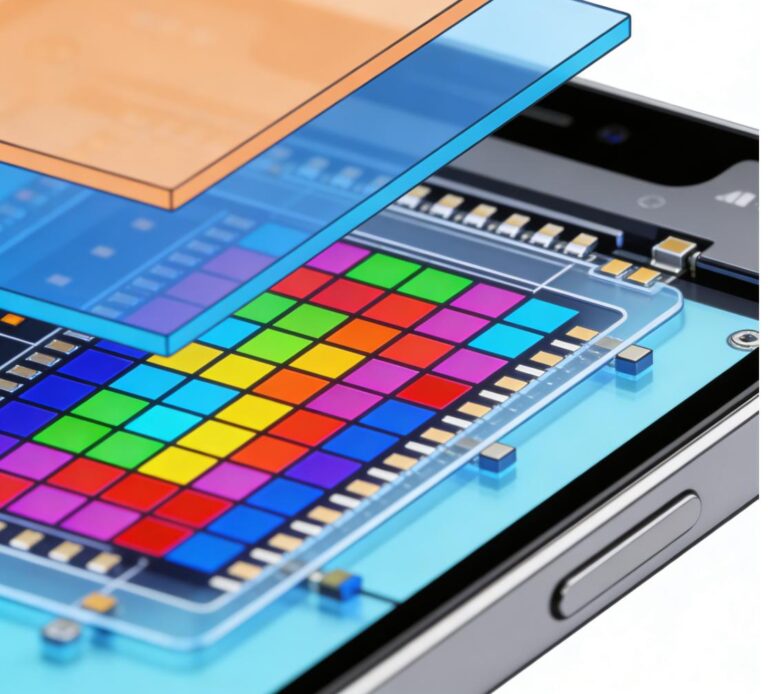
The functional mechanism of a resistive touchscreen is quite simple and reliable. Both layers have conductive traces arranged horizontally and vertically. These traces are sometimes called “bus bars.”
As pressure is applied to the screen, the two resistive layers touch each other at that point. This causes a change in the resistance of that area. Based on that change, the touchscreen controller calculates the coordinates of that touch.
Because this is a function of the pressure, rather than the conductivity, the touchscreen can detect input from a variety of items, not just the human hand. Resistive touchscreens are very versatile as a result.
2. Main Parts of a Resistive Touch Screen
Knowing the composition of a resistive touch screen is very helpful in understanding how it functions. Every part of the touch screen has its own distinct purpose.
Top Layer (Flexible Clear Film)
The top layer is usually made of polyester or other flexible transparent material, which is the part that the user comes into direct contact with.
The primary purpose of this part is to curve inward in response to touch or pressure. It allows the top layer to touch the bottom layer, which results in touch recognition. Since it is elastic, it is more likely to wear out.
Spacer Dots or Adhesive Spacers
The dots are placed between the top and bottom sheets. The main reason for these dots is to maintain a certain gap when the screen is not being touched.
It keeps the layers from accidentally touching each other, thereby inhibiting false touch signals. The quality of the spacers and their distribution have a great effect on the accuracy and durability of the touchscreens.
Bottom Layer (Glass or Hard Plastic)
The bottom layer is usually rigid and made either from glass or hard plastic material. It is responsible for giving structural support to the resistive touch screen technology.
This layer is also coated with a resister layer in a grid pattern. The grid pattern is used to sense the exact point where the top layer is in contact.
Resistive Coating
Both layers receive a coating of a transparent conductive material, usually indium tin oxide (ITO).
This coating is what makes it possible for the system to detect variations in the electrical resistance. It is these variations that make it possible for the touch coordinates to be determined.
Bus Bars (Conductive Strips)
Bus bars are thin conductive strips laid along the edges of the layers. They carry the signals from the resistive layer to the controller.
The location and quality of sensors affect the stability and precision of the received signals.
Touch Controller
It should be noted that the touch controller is an electronic component responsible for the processing of signals from the resistive touch screen.
The result of this process is the conversion of resistance into digital X and Y values, which are sent to the main processor of the device. It is not possible to achieve precise results from a resistive touch screen without a controller.

4. Types of Resistive Touchscreens
There are two popular types of resistive touch technologies. They are used for different purposes.
Digital Resistant Touch Screens
Resistive Touch Screens use a fixed X-Y matrix. They work based on finding the point where a pressing effect occurs.
These types of screens are commonly employed in ATMs, vending machines, industrial panels, and point-of-sale terminals. They are very durable, easy to interface with, and work well with fingers, styluses, or even with gloves.
Analog Resistive Touchscreens
Analog resistive touch screens react to continuous pressure. They are commonly employed in applications where accuracy is required.
These are normally used in pen-based computers, medical equipment, and other specialized devices. Analog touchscreens are capable of providing higher resolutions as well as smoother input, though they are more complicated when it comes to calibration.
5. Advantages of Resistive Touchscreen Technology
Despite the competition posed by other technologies, the resistive touchscreen still has many benefits.
- One of the advantages of resistive technology is its cost-effectiveness. This is because it is cheaper compared to capacitive technology, and therefore, it can be applied where cost is a factor.
- Ease of integration is another benefit. They support a variety of operating systems. They can work with Windows, Linux, or Android operating systems. They can be connected using USB or serial communication.
- A resistive touchscreencan also be operated with various inputs. It is functional with gloves, a stylus, and tools. It is most useful in an industrial setting or outdoors where operating with bare hands is not convenient.
- Further, resistive touch technology provides dust, moisture, and humidity resistance. When properly sealed with a gasket bezel, this type of display can operate well in dirty and/or wet environments.
6. Limitations of Resistive Touchscreens
Though functional, the technology used in resistive touchscreens has several drawbacks that must be kept in mind.
However, the top layer may be prone to scratching. The repeated application of pressure may cause the layer to be less sensitive and less clear over time. When damaged, the layer must be replaced in its entirety if it is part of a touchscreen display.
Visual performance is the next limitation. Additional layers are placed on top of the display. Therefore, the contrast and the level of brightness can be slightly affected. This is especially the case when the display is placed in a bright outdoor setting.
7. Application Areas
Resistive Touch Technology is being employed in ATMs, industrial control panels, kiosks, home appliances, and embedded systems. For such purposes, robustness and cost management are of prime importance rather than multi-touch capabilities.
Easy Quick, as a manufacturer, combines resistive touch solutions with displays that are stable and long-lasting. This is important for use in the industry.
Conclusion
In conclusion, knowing how a resistive touchscreen works and its strengths will allow one to make an informed choice. Although a capacitive screen will not be replaced anytime soon, a resistive touchscreen will remain a useful alternative for many purposes.