
1.Introduction: The Misleading Name of LCD Displays
The term LCD displays — short for Liquid Crystal Display — often confuses people. The phrase “liquid crystal” sounds contradictory: how can something be both liquid and solid? In reality, LCDs are not filled with a sloshing liquid like water. Instead, they contain a thin layer of liquid crystal molecules that exhibit properties between those of conventional liquids and solid crystals. Understanding how this unique state of matter functions is essential to appreciating why LCDs became the foundation of modern display technology.

2.The Science Behind LCD Displays
2.1 What Are Liquid Crystals?
Liquid crystals (LCs) are organic compounds that flow like a liquid but have some ordered molecular arrangement like a crystal. Their molecules, usually long and rod-shaped, align in predictable directions depending on external forces such as temperature or electric fields.
Liquid crystals exist in different phases:
Nematic phase: molecules are aligned in roughly the same direction but not fixed in position — the type used in LCDs.
Smectic and cholesteric phases: more structured forms used in specialized optical devices.
The nematic phase operates optimally between 20°C and 60°C, a range ideal for consumer electronics.

2.2 Structure of LCD Displays
An LCD display typically consists of six key layers:
Polarizer film (front)
Glass substrate with transparent electrodes
Liquid crystal layer (about 5–10 micrometers thick)
Second glass substrate with electrodes
Color filter
Rear polarizer and backlight unit
These layers are tightly sealed, so although the liquid crystal material is indeed “liquid,” it cannot move freely or leak out under normal use.
3.How LCD Displays Work
When no voltage is applied, the liquid crystal molecules are naturally twisted — typically by 90 degrees — rotating the light polarization as it passes through. When an electric field is applied, the molecules align parallel to the field, changing how light passes through the panel.
3.1 Light Control Mechanism
The backlight emits white light.
The light passes through the first polarizer.
The liquid crystal layer either rotates or blocks the light depending on the voltage applied.
The second polarizer and color filter determine the final color and brightness of each pixel.
This control allows precise adjustment of brightness in millions of subpixels (typically 1920 × 1080 × 3 = 6.2 million subpixels in a Full HD panel).
3.2 Quantitative Characteristics
Response time: ~5–10 ms for typical TN panels
Contrast ratio: around 1000:1 to 1500:1
Operating voltage: approximately 3–5 V per pixel
Power efficiency: around 20–30% of the backlight energy converted to visible light due to polarizer losses
4.Are LCD Displays Truly “Liquid”?
The answer is partially yes — but functionally no. The liquid crystal layer is indeed in a liquid state at the molecular level, but it is sandwiched and fixed between two solid glass plates. The material does not flow or move freely like water. Instead, it changes orientation under electric fields, which modifies its optical properties.
In essence:
The “liquid” aspect refers to molecular mobility.
The “crystal” aspect refers to ordered molecular alignment.
The display is a solid device — stable, sealed, and safe to handle.

5.Broader Applications of Liquid Crystals
The unique behavior of liquid crystals extends beyond LCD displays. They are used in:
Smart windows: adjusting transparency based on voltage or temperature.
Optical shutters: in cameras or 3D glasses.
Biosensors and medical diagnostics: detecting molecular interactions by optical changes.
In each application, the ability of liquid crystals to modulate light without moving mechanically is the key advantage.
6.LCD Displays vs. Other Display Technologies
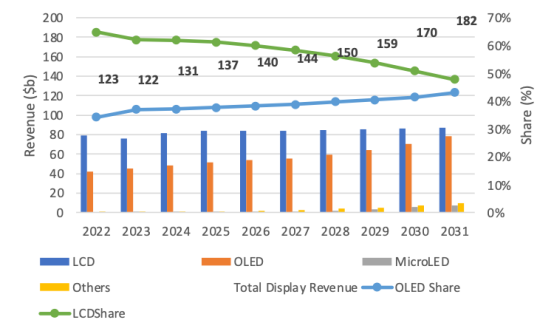
While OLED and MicroLED displays are gaining popularity, LCDs remain dominant in industrial, automotive, and consumer applications due to their maturity, cost-effectiveness, and reliability. For example:
LCD production yields above 95%, while OLED often averages around 80–85%.
LCD modules can last over 50,000 hours, compared to 20,000–30,000 hours for OLED.
This combination of long lifespan, stable operation, and precise optical control keeps LCD displays competitive despite newer technologies emerging.
Conclusion
So, are LCD displays actually liquid? The accurate answer is: they contain a liquid crystalline material, but the display itself is solid. The “liquid” in Liquid Crystal Display refers to a special state of matter that bridges fluidity and order, enabling light modulation without any moving mechanical parts.
This elegant principle — manipulating molecular orientation rather than physical structure — is what makes LCD technology both scientifically fascinating and practically enduring, even in an era dominated by next-generation display innovations.
At Shenzhen Easy Quick Technology Co., Ltd., we specialize in the design, development, and manufacturing of LCD display modules, including TFT, IPS, and custom LCD solutions. With advanced production facilities and years of industry expertise, we provide reliable, high-performance displays tailored for industrial, automotive, medical, and consumer electronics applications. Our commitment is to deliver precise visual performance and stable quality that meet the evolving needs of global partners.