
OLED vs LCD Screen: Core Material Differences
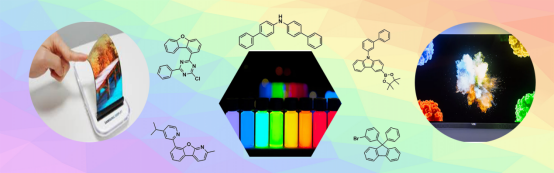
When discussing OLED vs LCD screen, the first distinction lies in the materials that enable image formation. OLED relies on organic light-emitting compounds, while LCD depends on liquid crystal molecules combined with external backlighting. These fundamental choices define how each technology performs and evolves.
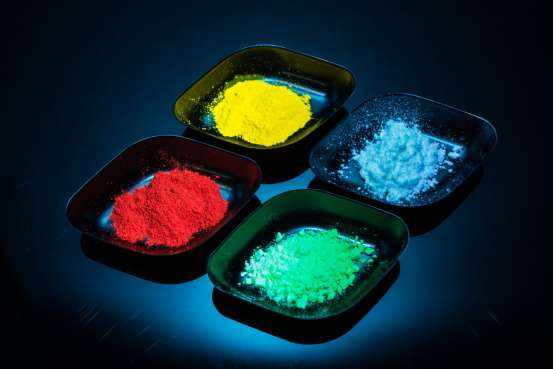
OLED Materials and Structure
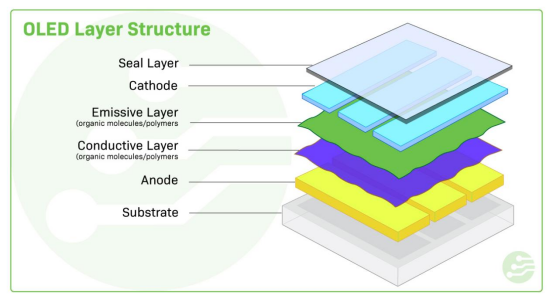
Organic Layers
An OLED panel is composed of several ultra-thin organic films, each with a unique role:
Hole Injection Layer (HIL) and Hole Transport Layer (HTL) transfer positive charges.
Emissive Layer (EML) contains organic compounds that emit red, green, or blue light.
Electron Transport Layer (ETL) ensures efficient electron flow.
Each of these layers is only around 100–200 nanometers thick, yet they determine brightness, efficiency, and lifespan.
Electrodes
Anode: Transparent Indium Tin Oxide (ITO), allowing light to exit the panel.
Cathode: Metals such as aluminum, calcium, or magnesium.
The combination ensures charge injection into the organic layers.
Substrates and Encapsulation
Substrates: Glass for rigidity, or Polyimide (PI) for flexible OLEDs.
Encapsulation: Thin-Film Encapsulation (TFE) or glass capping is critical to protect sensitive organics from oxygen and moisture. Without proper sealing, OLED degradation can occur within hours.
LCD Materials and Structure
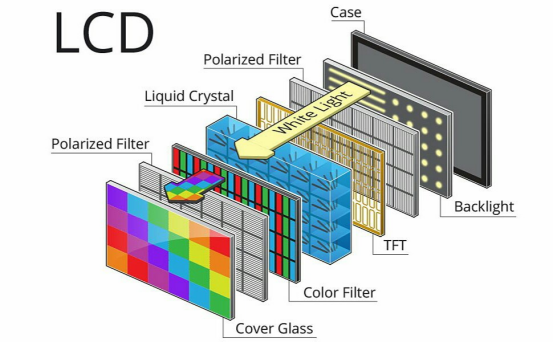
Liquid Crystal Layer
LCD uses non-emissive liquid crystal molecules. Their orientation under an electric field controls the passage of light. Popular modes include TN, IPS, and VA, each defined by the molecular alignment pattern.
Polarizers and Color Filters
Polarizers: Made from stretched polyvinyl alcohol (PVA) films with iodine doping, controlling light polarization.
Color Filters: Red, green, and blue dyes or pigments printed onto a glass substrate, converting white backlight into full-color images.
Backlight System
Unlike OLED, LCDs require a backlight unit (BLU):
LEDs: White LEDs are most common; RGB LEDs are used for high-end panels.
Optical Films: Diffusers, prism films, and reflectors improve light uniformity and brightness.
This backlight alone accounts for about 30–40% of LCD module thickness.
Glass Substrates and Alignment Layers
Glass Substrates: 0.5–1.1 mm thick aluminosilicate glass provides structural stability.
Alignment Layer: Usually polyimide (PI) coatings rubbed to align liquid crystal molecules.
OLED vs LCD Screen: Materials and Structural Comparison
Table: OLED vs LCD Screen – Materials and Structural Comparison
| Category | OLED (Organic Light Emitting Diode) | LCD (Liquid Crystal Display) |
| Light Source | Self-emissive organic compounds (R/G/B) | External LED backlight |
| Active Layer | Organic thin films (HIL, HTL, EML, ETL) | Liquid crystal molecules (TN, IPS, VA, etc.) |
| Electrodes | Transparent anode (ITO), cathode (Al, Ca, Mg) | Transparent electrodes (ITO) |
| Substrate | Glass or flexible plastic (Polyimide) | Glass (0.5–1.1 mm thick) |
| Color Control | Direct RGB emission from organic materials | RGB color filters on glass |
| Optical Films | Not required (light emitted per pixel) | Polarizers (PVA films), prism films, diffusers |
| Encapsulation | Thin-Film Encapsulation (TFE) or glass cover to block O₂ & H₂O | Simple sealing with epoxy and glass |
| Thickness | < 1 mm (ultra-thin, bendable) | 2–3 mm (due to backlight & multiple film layers) |
| Durability | Sensitive to oxygen/moisture, blue emitter lifespan shorter | Stable, long lifespan (50,000–60,000 hours) |
| Manufacturing | Vacuum deposition, expensive organic materials | Mature large-panel production, lower cost per unit |
What These Materials Mean for the Future
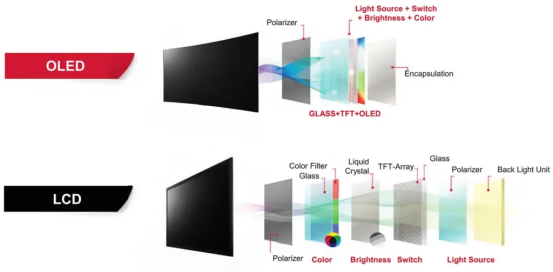
OLED: Organic compounds enable flexibility, ultra-thin panels, and high contrast. However, limited blue emitter lifespan and complex encapsulation remain challenges.
LCD: Inorganic materials, glass, and stable polarizers provide durability and cost efficiency. The structure, though thicker, ensures long-term stability.
The choice between OLED vs LCD screen materials reflects more than performance—it reveals different paths in manufacturing, sustainability, and design possibilities.
Conclusion: Materials Drive Innovation
In the debate of OLED vs LCD screen, the core materials explain why OLED dominates flexible and high-end devices, while LCD remains strong in reliable, cost-sensitive markets. Understanding these material differences helps designers, engineers, and buyers choose the right display technology for their product vision.
👉 At Shenzhen Easy Quick Technology, we specialize in custom OLED and LCD modules, with expertise in both organic and liquid crystal material engineering. Contact our team today to explore how material innovation can bring your display concepts to life.