
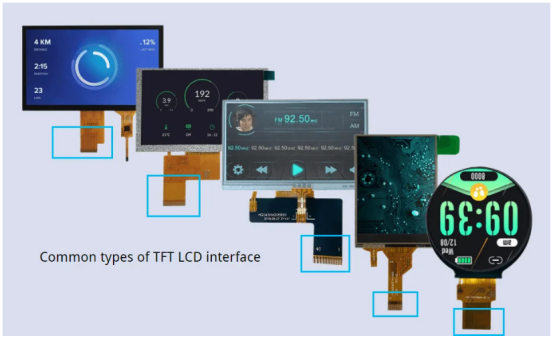
Choosing the right interface is one of the most important decisions when customizing a TFT LCD display for your product. The display interface directly affects image quality, power consumption, data transmission speed, compatibility, and even the overall product size. With increasing demand for high-performance display modules in industrial, automotive, medical, and consumer devices, understanding the differences between display interfaces is essential for engineers and product designers.
Understanding TFT LCD Display Basics
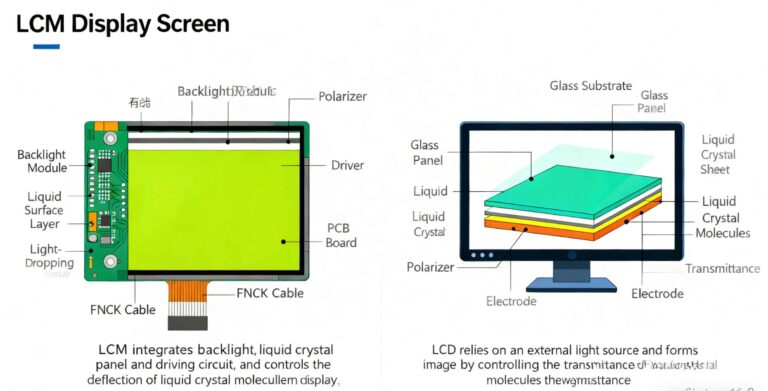
Before digging into interfaces, it’s useful to review how TFT LCD displays work. A TFT (Thin Film Transistor) LCD consists of three major parts:
Driver IC — controls the pixel matrix
Backlight system — typically LED-based, with brightness ranging from 250 to 1,000 nits
Display glass — defines the resolution and viewing performance
A standard TFT LCD Display communicates with the host processor through an interface that transfers pixel data, timing signals, and control commands. The selection of the interface must match system requirements such as frame rate, resolution, MCU/CPU capability, and power budget.
Types of Interfaces for TFT LCD Display Modules
Different interfaces offer different transmission speeds, physical connector layouts, and compatibility features. Below are the most widely used ones:
1. RGB Interface
The RGB interface is one of the earliest and most commonly used parallel interfaces.
Key characteristics:
16-bit or 24-bit transmission
Supports up to 60 FPS
Ideal for resolutions below 800×480
Advantages:
Simple structure
Direct connection to many MCUs and MPUs
Stable and low-latency
Limitations:
Requires many pins (typically 40–50 pins)
Higher EMI and wiring complexity
RGB is a great choice for products where real-time image update is critical and PCB layout space is not a major concern.

2. SPI (Serial Peripheral Interface)
SPI is a serial interface commonly used in compact devices or screens under 3.5 inches.
Key characteristics:
3–4 wire communication
Low cost and fewer pins
Suitable for icons, simple UI, and low-frame-rate content
Advantages:
Very low pin count
Easy to design and integrate
Low power consumption
Limitations:
Slow refresh rate (usually below 15 FPS)
Not suitable for animation or video
SPI is a preferred option for smart home devices, wearable tech, and battery-powered equipment.
3. MIPI DSI Interface
MIPI (Mobile Industry Processor Interface) is now widely used in high-resolution TFT LCD displays.
Key characteristics:
Transfer speed up to 1 Gbps per lane
Supports resolutions from 720p to Full HD and above
Typically 1–4 data lanes
Advantages:
Fast data transfer
Fewer pins compared to LVDS
Excellent for vivid, smooth image rendering (60–120 FPS)
Limitations:
Requires more advanced processors
Layout requires stricter signal integrity considerations
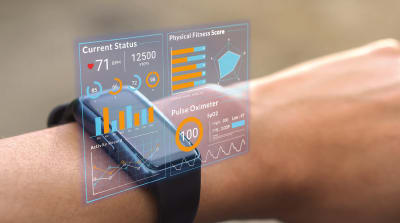
MIPI is commonly used in smartphones, tablets, and high-end IoT devices requiring rich graphics.
4. LVDS (Low-Voltage Differential Signaling)
LVDS is known for stability and noise immunity.
Key characteristics:
Excellent for long cable transmission
Ideal for 7-inch to 15.6-inch displays
Supports 1366×768 or higher resolutions
Advantages:
Strong anti-interference
Lower power consumption at high speeds
Reliable for industrial and automotive applications
Limitations:
Higher cost
More complex design requirements
If your product needs stable performance in harsh environments, LVDS is a strong candidate.
How to Choose the Right Interface for Your TFT LCD Display
Selecting the right interface requires evaluating both technical and product-level requirements. The following criteria help narrow down the decision:
1. Resolution Requirements
Low resolution (≤ 480×272) → RGB or SPI
Medium resolution (800×480 — 1024×600) → RGB or LVDS
High resolution (≥ 720p) → MIPI
Higher resolution means larger pixel data, so interfaces with higher bandwidth are required.

2. System Processor Compatibility
Microcontrollers (like STM32) → RGB / SPI
Application Processors (ARM Cortex-A) → MIPI / LVDS
Automotive CPUs → LVDS or MIPI
Always check whether your CPU supports the interface at your target resolution and frame rate.
3. Power Consumption Considerations
MIPI is often more power-efficient than LVDS at high speeds, making it ideal for portable devices.
SPI consumes very little power but sacrifices speed.
RGB consumes moderate power but demands many I/O pins.
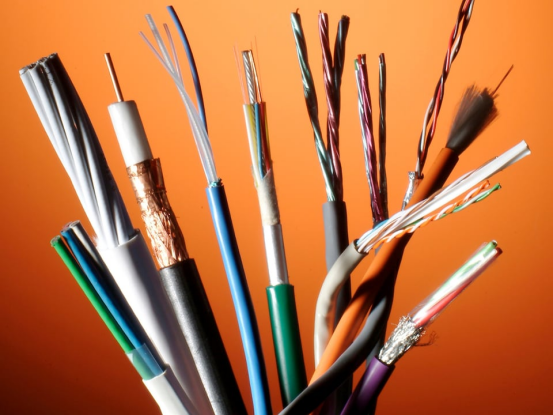
4. Cable Length and EMI Control
Long cable → LVDS
Short cable and compact design → MIPI or RGB
Extremely limited PCB area → SPI
Additional Customization Options for TFT LCD Display Modules
Choosing the interface is just one part of customization. Other technical parameters also impact performance:
Brightness Levels
Standard: 250–350 nits
High-bright: 800–1,000 nits
Ultra-high: ≥1,500 nits
High-bright displays are necessary for outdoor equipment or vehicle dashboards.
Operating Temperature
Industrial-grade TFT modules typically operate from:
-20°C to +70°C or even -30°C to +85°C
This ensures reliability in harsh environments.
Touch Panel Options
Resistive touch (simple & durable)
Capacitive touch (multi-touch, high transparency)
Custom Backlight Design
Including:
LED lifetime (30,000–50,000 hours)
Uniformity requirements
Power efficiency
Conclusion
Customizing a TFT LCD Display for a project requires understanding key parameters—especially the display interface. Whether you choose RGB, SPI, MIPI, or LVDS, the right interface ensures smooth data transmission, high image quality, and system compatibility. Evaluating resolution, processor capability, power consumption, and physical constraints will help you make an accurate and long-term decision. With proper customization, a TFT LCD Display can significantly enhance the overall performance, reliability, and user experience of your device.
Need a custom TFT LCD Display with the right interface and long-term supply stability?
Our engineering team provides full customization, including interface adaptation, touch integration, optical enhancement, and wide-temperature designs.
Reach out to us now and let’s build the ideal display solution for your application.