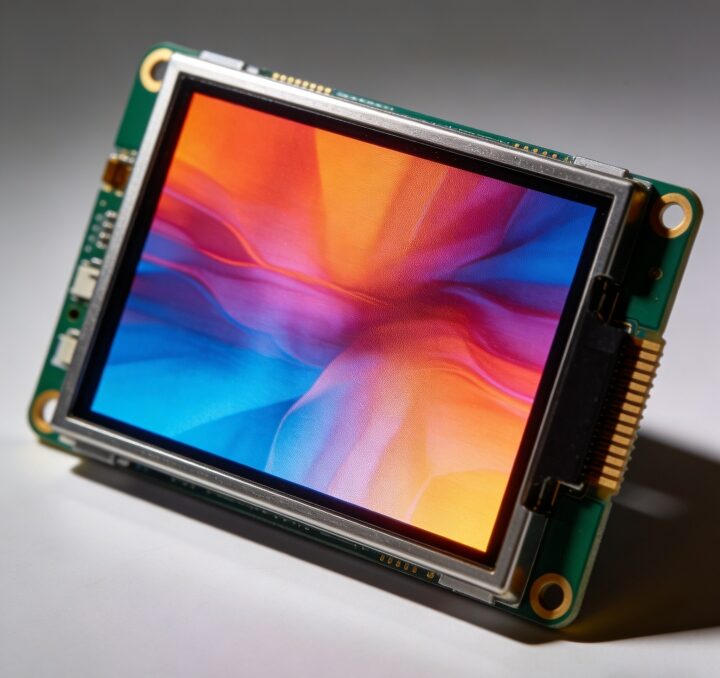

You have meticulously selected a high-performance Microcontroller (MCU) and a high-resolution TFT LCD for your latest industrial project. The CAD models look perfect, and the UI design is sleek. However, when the first prototype arrives, the screen remains blank, or worse, it displays erratic “snow” and flickering lines.
This is the reality of interface conflicts—the single biggest cause of project delays in industrial display integration. In the B2B world, time-to-market is everything. A compatibility issue isn’t just a technical bug; it’s a financial drain. Why do these conflicts happen, and how can you guarantee that your MCU and display will talk to each other seamlessly from the first power-on?
1. The Common Scenarios: Where Integration Goes Wrong
Interface conflicts typically arise in demanding applications where reliability is non-negotiable. Whether you are designing medical diagnostic equipment, heavy-duty agricultural controllers, or motorcycle digital clusters, the environment demands stable data transmission.
The conflict usually manifests in three ways:
The “Silent” Screen: The MCU sends data, but the LCD Driver IC doesn’t recognize the protocol.
Signal Degradation: The display works in the lab but fails in the field due to Electromagnetic Interference (EMI).
Timing Mismatch: The image is shifted or “tearing” because the MCU’s pixel clock (PCLK) isn’t synchronized with the LCD’s requirements.
2. Technical Deep-Dive: 3 Pillars of MCU-LCD Compatibility
To avoid these pitfalls, engineers must look beyond the resolution and brightness specs. You need to focus on the Electronic DNA of the connection.
A. Protocol Selection (SPI vs. RGB vs. LVDS vs. MIPI)
The interface is the “language” your devices speak.
MCU/i80 Interface: Ideal for low-power, static images. If your MCU has limited RAM, this is your best bet.
RGB Interface: High speed, but requires a constant clock signal, which can lead to high EMI if not routed correctly.
LVDS/MIPI: The standard for high-definition displays (like rugged tablets). These use differential signaling to cancel out noise, but they require MCUs with specialized hardware controllers.
The Conflict: Trying to drive a high-res RGB screen with a low-end MCU without a dedicated LCD controller will lead to sluggish performance and system crashes.
B. Logic Level and Voltage Fluctuations
Most modern industrial MCUs operate at 3.3V, but many TFT LCDs have specific requirements for their I/O pins. Even a 0.5V discrepancy in the Logic High (VIH) level can cause intermittent data loss. Without proper Level Shifting, you risk long-term damage to the Driver IC or unstable performance under extreme temperatures.
C. The Timing Challenge (Signal Integrity)
Industrial environments are “noisy.” Long FPC (Flexible Printed Circuit) cables act as antennas for interference. If the Setup and Hold times of your MCU signal don’t match the LCD’s datasheet precisely, the data will be sampled incorrectly, leading to “ghosting” or color inversion.
3. The “Expert Guide”: How to Choose the Right Setup?
Before you commit to a supplier, ask yourself these three questions:
What is my MCU’s maximum clock speed? Don’t pair a 50MHz MCU with a display that requires 100MHz for a smooth 60fps.
Does the supplier provide initialization code? A reliable partner should give you the “C” code or library to initialize the Driver IC (like ILI9341 or ST7789).
Is the FPC length optimized? For industrial displays, shorter is usually better for signal integrity, but custom routing is often needed to fit your enclosure.
4. Why Easyquick is Your Engineering Partner, Not Just a Vendor
At Easyquick LCD, we understand that you aren’t just buying a component; you are buying a solution. We bridge the technical gap between your MCU choice and the visual output.
Pre-Sales Compatibility Audit: Our engineers review your MCU schematic before you even place a sample order. We ensure the pinout and voltage levels are a 100% match.
Customization without Complexity: Need a custom FPC to match your unique PCB layout? We offer low-MOQ customization for interfaces like SPI, RGB, and UART HMI.
Rapid Prototyping: We know you are on a deadline. Our technical team can deliver modified samples in 2-3 weeks, complete with the necessary driver support for platforms like STM32, ESP32, and NXP.
5. Frequently Asked Questions (FAQ)
Q: Can I use a standard 3.3V MCU with a display that requires 5V for backlight? A: Yes, but you must ensure the logic signals are isolated from the backlight power. We design our modules with integrated backlight drivers to simplify your PCB design.
Q: What is the maximum distance between my MCU and the LCD? A: For RGB interfaces, we recommend keeping it under 15cm to avoid EMI issues. For longer distances, we suggest moving to an LVDS or RS232/RS485 HMI solution.
Q: Do you support custom initialization for non-standard resolutions? A: Absolutely. Our R&D team provides the full register settings and timing parameters needed for your specific MCU’s display controller.
6. Take the Next Step
Don’t let interface conflicts stall your project. A 15-minute consultation with our engineers can save you weeks of troubleshooting.
Let’s ensure your next industrial display project is a plug-and-play success.