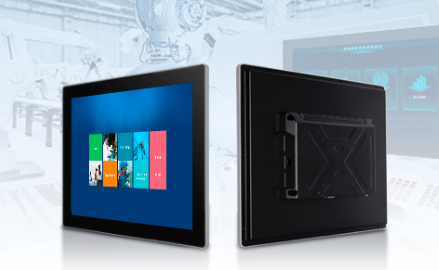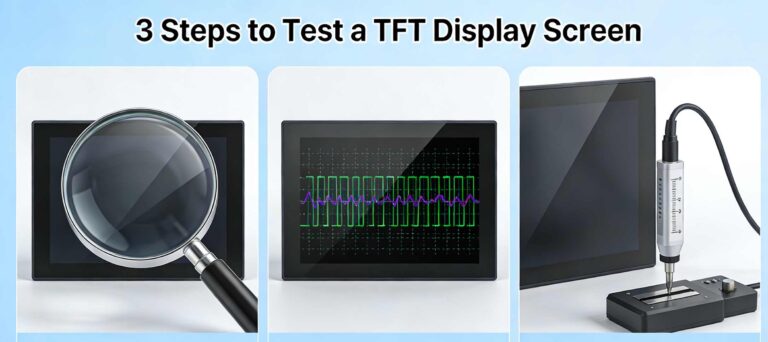

In the world of industrial panels, digital signage, and embedded technologies, the choices for display technologies could go for either an LED display or a backlit TFT LCD. This is something that people who are on the lookout for these types of equipment ask: How are these two technologies different from each other? Both can display full color images and videos, but they go in different directions regarding their operation principle, display characteristics, available display sizes, energy consumption, and appropriate applications. This article will help you compare the differences between LED displays and backlit TFT LCDs.
What Is an LED Display?
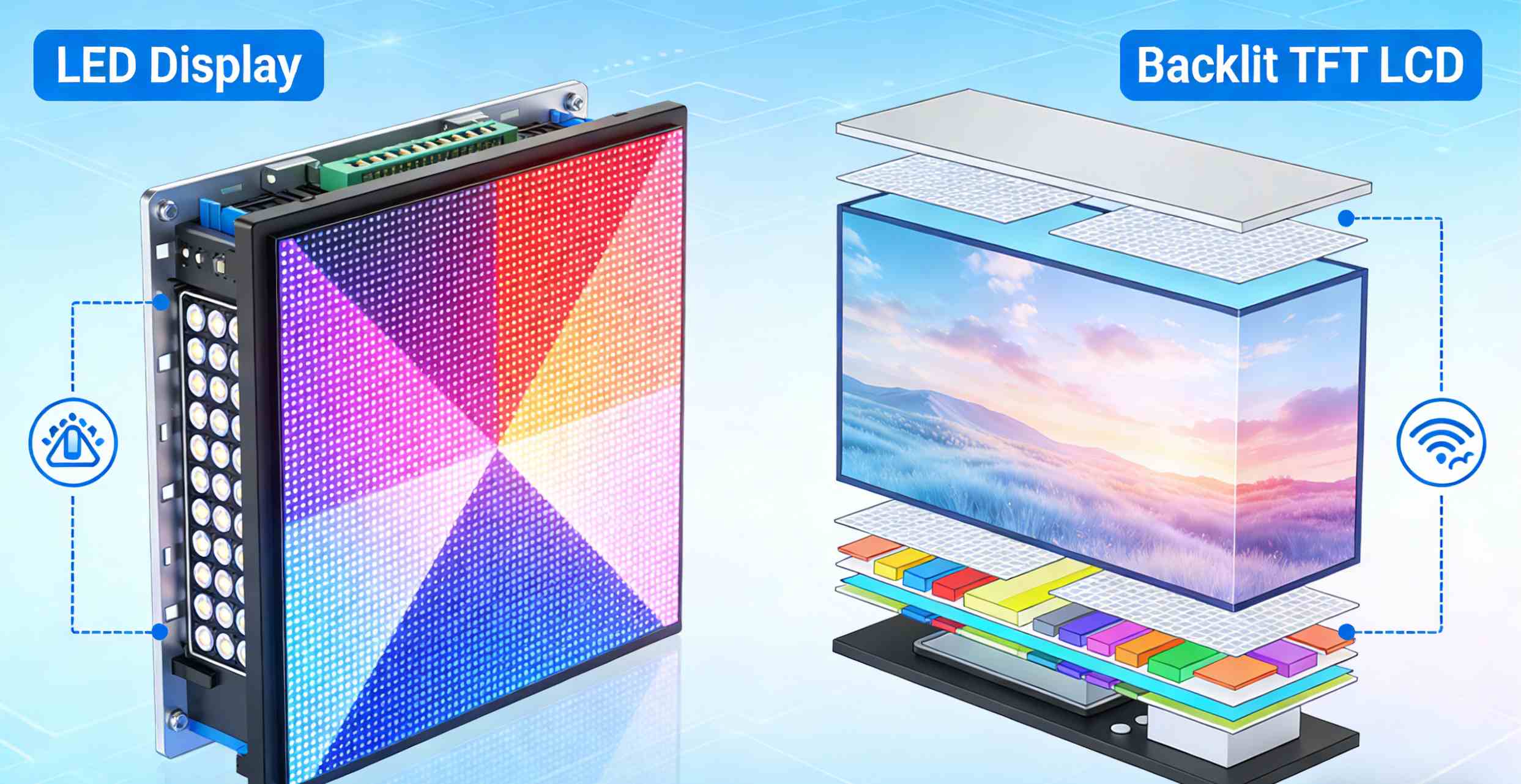
An LED display is a self-emitting display that consists of a matrix of light-emitting diodes. This is because every pixel on an LED display lights up individually, eliminating the need for a backlight. Through intensive illumination of red, blue, or green diodes, images can be directly displayed on this display type.
Generally, the LED display is organized in a modular form. There are several LED modules that are mounted together to make up the full-screen display, making it simpler to increase or resize the display as desired. Because each pixel provides illumination, the LED display is very bright and is clearly visible even under ambient lighting conditions. One could sum up that these screens prioritize bright illumination and long-distance visibility rather than high image resolution.
What Is a Backlit TFT LCD?
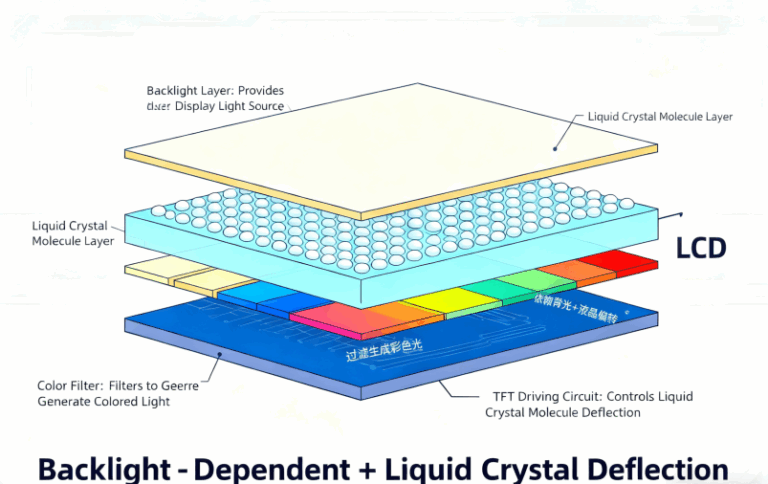
In a backlit TFT LCD, LEDs illuminate the display. The illumination is even, but it is modulated by the amount of illumination that is transmitted through the liquid crystal layer, where TN technology is used in the liquid crystal. On the structural front, a backlit TFT LCD is a layered construct of various materials, which include the LED backlight unit, liquid crystal layer, polarizers, and glass substrates. Being a layered component, this facilitates a consistent display quality with respect to brightness. In the TFT system, the quality of the images is improved through high resolution and color accuracy, an aspect crucial for text and images.

LED Display vs Backlit TFT LCD: Key Specifications Comparison
| Item | LED Display | Backlit TFT LCD |
| Light source | Self-emissive pixels | LED backlight + liquid crystal |
| Resolution | Lower at small sizes | High resolution |
| Display size | Very large, scalable | Small to medium sizes |
| Image detail | Moderate | Excellent |
| Viewing distance | Medium to long distance | Short distance |
| Power consumption | Higher | Lower |
| Typical use | Advertising, stage display | Industrial, medical |
1. Display Performance: Brightness vs Clarity
- Brightness performance:
In terms of extreme brightness, LED is best. The brightness level for backlit TFT LCD is medium to high, and there is a facility to enhance the brightness to higher levels by using high-brightness backlights. - Image clarity:
While LED screen size may be restricted in small LCDs due to pixel pitch, the use of a Backlight TFT LCD ensures that the images are rendered with high pixel density, which makes the text and images clear and legible. - Color consistency:
LED displays may show slight differences between modules. Backlit TFT LCDs deliver more consistent and stable color performance.
2. Size Range and Pixel Density
- LED displays: best for large sizes
LED displays are typically used for screens larger than 30 inches and can be expanded to very large video walls. Pixel pitch is relatively large, making them more suitable for long-distance viewing. - Backlit TFT LCDs: ideal for small to medium sizes
Common sizes range from 2 to 15 inches. High pixel density allows clear viewing at close distances, which is essential for user interaction and detailed information display.
3. Power Consumption and Service Life
- LED displays:
Higher brightness generally results in higher power consumption. However, LED chips have long service lives and are suitable for continuous operation. - Backlit TFT LCDs:
Less power consumption, which is a benefit for applications requiring embedded systems. Typical lifetimes of industrial-grade backlights are 30,000 to 50,000 hours under stable conditions.
4. Cost and System Integration
- LED displays:
Initial investment is relatively high, including display modules, power supplies, control systems, and installation structures. They are better suited for large commercial display projects. - Backlit TFT LCDs:
With a mature supply chain, unit cost is well controlled. Standard interfaces make them easy to integrate into various systems and devices.
How to Choose the Right Display Solution?
When selecting between an LED display and a backlit TFT LCD, the key is not which technology is more “advanced,” but which one best matches your application requirements.
- Choose an LED display
If you need a large size, high brightness, and long-distance viewing.
LED displays are ideal when the screen size exceeds 30 inches or needs to be expanded through modular assembly. Their high brightness ensures clear visibility in outdoor or strong-light environments, and they are best suited for applications where visual impact is more important than fine image detail. - Choose a backlit TFT LCD
If you need high resolution, fine image quality, and long-term stability.
Backlit TFT LCDs excel at displaying text, charts, and detailed graphics. They are well-suited for close-range viewing and frequent operation. In industrial, medical, and embedded systems, their low power consumption, stable performance, and interface compatibility make them a reliable choice.
Conclusion
LED displays and backlit TFT LCDs are not competing technologies, but complementary solutions designed for different application needs. LED displays remain the preferred option for large-scale, high-brightness visual presentation, while backlit TFT LCDs continue to be the most reliable and cost-effective solution for industrial control, medical equipment, and embedded systems.
As a professional display solution provider, Easy Quick offers a wide range of LCD products in various sizes and specifications. If you are unsure which display solution best fits your project, contact us for expert advice and customized display solutions tailored to your application.