
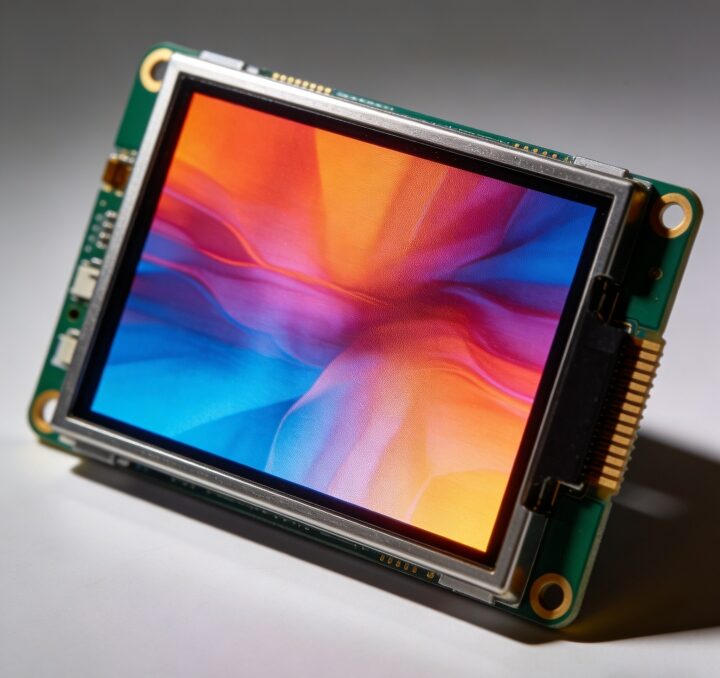
LCD interfacing is one of the most crucial aspects of modern electronics and embedded system design. Whether in industrial control panels, consumer electronics, or automation systems, the interface between the LCD and the controller determines its performance, power consumption, and complexity, thus impacting its cost.
This article focuses on the most commonly used LCD interfacing interface types, their data transmission methods, and their common application areas.
What LCD Interfacing Means in Practice
LCD interfacing is a method that is used to transfer image data, control signals, and timing information between a display and a host system such as a microcontroller, microprocessor, or embedded board. Each LCD panel requires:
- Power and ground connections
- Control signals, including but not limited to reset, enable, chip select, etc.
- Data lines to carry pixel or command information
It defines how many wires there are, the speed at which data can be sent, and how complex the software and hardware design is.
The method of interfacing used while choosing the right LCD determines the following:
- Refresh rate of the display
- Resolution support
- PCB Layout Difficulty
- EMI performance
- Overall cost of the system
1. Parallel LCD Interfacing
One of the earliest and most straightforward methods of interfacing is parallel LCD interfacing. In parallel LCD interfacing, several data lines are used to carry bits all at the same time from the controller to the LCD.
How Parallel LCD Interfacing Works
In parallel LCD interfacing, the data transfer is done through:
- 8-bit, 16-bit, or even 24-bit data buses
- Split control lines for read/write, enable, and register select
- Since each clock cycle sends a full byte or word of data, this interface is considered quite fast.
Advantages of Parallel LCD Interfacing
- High data throughput
- Easy logic of communication
- Easy to understand and debug
- Limitations
- Requires many GPIO pins
- Complex PCB routing
- Poor scalability for small devices
Parallel interfacing is still common in industrial HMIs and older embedded systems, where pin availability is not a concern.
2. SPI LCD Interfacing
SPI is a widely used serial protocol in small and medium-sized LCDs, especially those used in mono and low-resolution color displays.
How SPI LCD Interfacing Works
- SPI interfacing of LCD uses
- Synchronous clock line (SCLK)
- MOSI data line
- Chip select (CS)
- Optional data/command line
Serially transmitted data, one bit at a time, synchronized with the clock.
Advantages of SPI LCD Interfacing
- Requires fewer pins.
- Simple hardware design
- Supported by most microcontrollers
Limitations
- Slower than parallel interfaces
- It is not good for high-resolution displays.
SPI LCD drives numerous wearable devices, pocket-sized instruments, and compact consumer electronics where pin count is considered important.
3. I²C LCD Interfacing
I²C LCD interfacing normally refers to the interaction of character LCDs and very low-bandwidth graphical displays.
How I²C LCD Interfacing Works
I²C utilizes only two lines:
- SDA (data)
- SCL (clock)
One bus can have several devices on it, all with different addresses.
Advantages of I²C LCD Interfacing
- Extremely low pin usage
- Simple wiring
- Good for control panels and text displays
Limitations
- Very low data rate
- Unsuitable for real-time graphics
The interfacing of I²C with LCDs normally finds its usage in temperature controllers, simple user interfaces, and educational projects.
4. RGB LCD Interfacing
RGB is again one of the well-known techniques for interfacing medium to high-resolution TFT displays, particularly in embedded systems.
How RGB LCD Interfacing Works
RGB LCD interfacing sends raw pixel data to the display directly using:
- Use separate red, green, and blue data lines.
- Horizontal sync, vertical sync, and pixel clock
The controller of the display continuously refreshes the screen depending on the data input.
Advantages of interfacing LCD using RGB
- High image quality
- Real-time display updates
- No frame buffer inside the LCD is needed
Limitations
- Very high pin count
- High-power consumption
- Complex timing requirements
The interfacing of RGB LCDs finds wide applications in automotive displays, industrial panels, and high-end embedded applications.
5. LVDS LCD Interfacing
The interfacing of LVDS for LCD is made for high-speed data transmission over a longer distance.
How LVDS LCD Interfacing Works
With LVDS, data is sent in differential pairs, which greatly reduces noise and permits higher clock speeds. Pixel data is serialized over fewer wires compared to RGB interfaces.
Advantages of LVDS LCD Interfacing
- The data rate is usually high.
- Excellent noise immunity
- High-resolution supported
Limitations
- Requires serializer/deserializer chips
- More complicated system design
The interfacing of the LVDS LCDs is widely used in many applications, such as in laptops, industrial monitors, and professional display systems.
6. MIPI DSI LCD Interfacing
The MIPI DSI can be marked as the most modern one, being very widely used in cellular phones, among other mobile devices.
How MIPI DSI LCD Interfacing Works
MIPI DSI uses:
- High-speed differential lanes
- Packet Switching
- Very low power operation
It has both command mode and video mode to be flexible for different display needs.
Advantages of MIPI DSI LCD Interfacing
- Very low pin count
- High bandwidth
- The best power efficiency
Limitations
- Complex protocol
- Requires proprietary controllers
MIPI DSI dominates the interfacing in smartphones, tablets, and compact high-resolution devices.
7. EDP LCD Interfacing
EDP stands for Embedded DisplayPort, an interface more recent and commonly used in laptops and advanced embedded systems.
Key Features of EDP LCD Interfacing
- High-resolution support
- Adaptive refresh rates
- Reduced power consumption
Interface EDP LCD – The best for thin devices that require the highest performance with minimal wiring.
Choosing the Right LCD Interfacing Method
The selection of an interfacing method with an LCD depends on a number of practical consideratio

ns:
- Display resolution and refresh rate
- Available pins on the controller
- Power Budget
- The constraints on the size of the PCB
- Software complexity
As a reliable supplier, EasyQuck can provide suitable LCD panel interface solutions for particular applications.
Common LCD Interfacing Design Challenges
Even with the proper interface, the LCD interfacing can become problematic:
- High-speed signal integrity issues
- The timing configuration is wrong
- Poor routing is causing EMI problems
- Incompatible voltage levels
A really good interface to LCD requires great care in schematic design, impedance control, and firmware tuning.
Conclusion
Each LCD interfacing solution has its own characteristics. EasyQuick can customize suitable LCD interfacing solutions to meet users’ display needs, thereby creating a stable, efficient system that meets the expectations of modern users. Contact EasyQuick for quick details on customized solutions.